
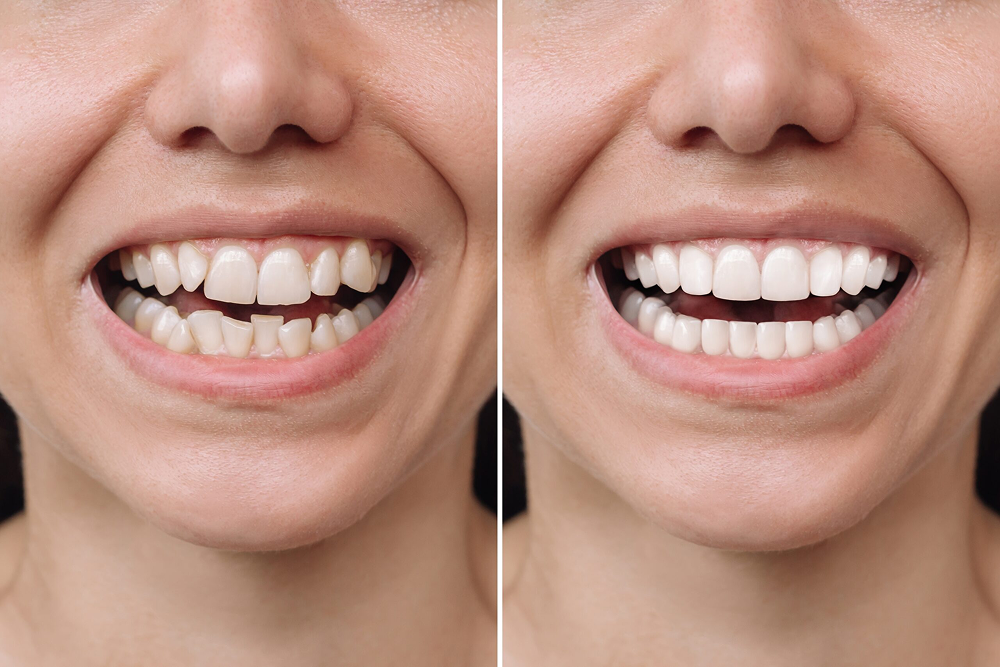
Dental veneers are wafer-thin, custom-shaded shells — made of porcelain, composite resin, or premium ceramic — bonded only to the visible front surface of a tooth to fix its colour, shape, chips, or small gaps, without touching the root or reshaping the whole tooth. In Hyderabad, they typically cost ₹5,000–₹40,000 per tooth depending on material, last 5–20 years, and are usually completed in 1–4 visits. They’re the fastest way to correct several small cosmetic flaws at once — but they’re not the right fix for decay, gum disease, or a bite that genuinely needs straightening.
A chipped front tooth. A greyish shadow left behind by an old filling. A gap that’s only really noticeable in photographs. None of these are dental emergencies — yet they’re often the one thing a person thinks about every time they smile. That quiet self-consciousness, more than the tooth itself, is the problem veneers actually solve.
At Krishna Dental Hospitals (KDH), veneers are among the most-requested cosmetic treatments across our Kondapur, Kukatpally, Kompally, and A.S. Rao Nagar branches — and also among the most misunderstood. Many patients assume a veneer is one-size-fits-all, when the material chosen actually changes the cost, lifespan, and how much natural enamel is altered. This guide breaks down what veneers do, where they’re used, which type fits which case, and current Hyderabad pricing to plan around.
What Are Dental Veneers, Exactly?
A dental veneer is a wafer-thin shell, roughly the thickness of a fingernail or contact lens, that’s custom-shaded and bonded only to the visible front surface of a tooth — not the whole tooth, and not its root.
Think of it as resurfacing rather than rebuilding. The tooth underneath stays exactly where it is; the veneer simply gives the part everyone sees a new colour, shape, and finish. That’s the key difference between a veneer and a dental crown, which caps the entire tooth and is used when the tooth itself needs structural rebuilding — after a root canal, for instance, or with significant decay. Veneers are a cosmetic-first solution for teeth that are otherwise structurally sound.
Common Uses for Veneers
Veneers exist to solve appearance problems on teeth that are otherwise healthy. The most common reasons patients come in for them are:
- Stubborn discolouration that whitening treatments haven’t touched — including staining from old fillings, certain medications, fluorosis, or teeth that have simply darkened with age.
- Chipped or cracked front teeth, especially a single incisor edge damaged in a fall, a fork, or a hard bite.
- Small gaps between teeth (mild diastema), where closing the space with orthodontics would be overkill for the size of the gap.
- Teeth that are unusually small, short, worn down, or irregularly shaped, which can make a smile look uneven even when every tooth is healthy.
- Minor rotation or unevenness along the smile line that a person wants softened without months of aligner treatment.
- Full smile makeovers, where 6–8 visible upper teeth are veneered together for a uniform colour and shape across the whole smile line.
It’s just as useful to know what veneers don’t fix. They don’t move teeth — a veneer can visually soften a slight tilt, but it can’t correct an actual bite problem or close a large gap caused by spacing or bone loss; that’s work for braces or clear aligners. They also don’t treat decay or gum disease — both need to be resolved first, since bonding a veneer over an unhealthy tooth simply locks the problem in underneath a cosmetic layer.
Primary Types of Veneers
The four common veneer materials trade off cost, longevity, and how much natural enamel is removed to fit them.
- Composite veneers are hand-sculpted directly onto the tooth, often finished in a single sitting. They’re the most affordable option and the easiest to repair, but they pick up stains faster and typically last 5–7 years.
- Porcelain veneers are lab-fabricated for a stronger, more stain-resistant finish that reflects light close to natural enamel. With normal care, they last 10–15 years or more, in exchange for an extra lab visit.
- E-Max (lithium-disilicate ceramic) veneers sit at the premium end — thinner, exceptionally strong, and prized for the most lifelike translucency, which is why they’re the common choice for full smile-design cases. They can last 15–20 years with good maintenance.
- No-prep veneers, including Lumineer-style options, need little to no enamel reduction, making the change more conservative and, in some cases, partially reversible — though they’re not the right fit for every bite or tooth shade.
Most single-tooth repairs use composite. Most full smile-design cases at KDH use porcelain or E-Max, since the added strength and translucency matter more when several teeth need to match perfectly.
Veneers vs. Crowns vs. Whitening: Which One Actually Fits Your Case?
This is the question patients should answer before they ever discuss materials — the wrong category of treatment can’t be fixed by choosing a better veneer.
| Your Situation | Better Fit |
|---|---|
| Teeth are structurally healthy but stained, chipped, gapped, or unevenly shaped | Veneers |
| Surface staining only, shape and alignment are already fine | Professional whitening |
| Tooth is cracked, heavily filled, or has had a root canal | Crown |
| Teeth are crooked or a large gap is caused by spacing/bone loss | Braces or aligners, veneers after if needed |
| You grind your teeth heavily without a nightguard | Crown (veneers can chip under repeated force) |
A useful rule of thumb: whitening changes shade only, veneers change shade and shape and minor position, and crowns rebuild a tooth that’s actually lost strength. One detail that surprises a lot of patients — once a veneer is bonded, its shade is fixed for good. Whitening doesn’t touch porcelain, composite, or ceramic, so if you’re planning to whiten your natural teeth as well, do it before your veneer shade is chosen, not after.
The Veneer Procedure at Krishna Dental Hospitals: What Each Visit Involves
A full porcelain or E-Max veneer case typically spans three to four visits — consultation and digital smile preview, minimal enamel preparation, a temporary fitting, and final bonding — while composite veneers can often be completed in a single appointment.
- Smile consultation and digital design — our cosmetic team reviews your oral health and uses digital smile design so you preview the result before any tooth is touched.
- Conservative tooth preparation — a layer thinner than a millimetre is reshaped, only where the veneer needs room to sit flush.
- Digital scan or impression — sent for lab fabrication, or processed in-house for composite cases.
- Temporary veneers — worn briefly while your permanent set is crafted to match shape, shade, and light reflection.
- Final bonding and polish — each veneer is checked individually for fit and shade before permanent cementing.
Most patients report only mild, short-lived sensitivity and describe the overall process as comfortable rather than painful.
Dental Veneers Cost in Hyderabad (2026 Price Guide)
| Veneer Type | Typical Cost (per tooth) | Expected Lifespan |
|---|---|---|
| Composite | ₹5,000 – ₹12,000 | 5–7 years |
| Porcelain | ₹10,000 – ₹25,000 | 10–15+ years |
| E-Max (Ceramic) | ₹20,000 – ₹40,000 | 15–20 years |
| No-Prep / Lumineer-style | ₹20,000 – ₹35,000 | 10–15 years |
Figures reflect current Hyderabad market ranges and vary with case complexity; confirm your exact cost at a consultation. Most full smile-design cases cover 6–8 visible upper teeth, so it’s more useful to budget by your smile zone than by a single-tooth price
Figures reflect current Hyderabad market ranges and vary with case complexity; confirm your exact cost at a consultation. Most full smile-design cases cover 6–8 visible upper teeth, so it’s more useful to budget by your smile zone than by a single-tooth price.
How Long Veneers Last — and Protecting Them in Hyderabad's Everyday Diet
Composite veneers commonly last 5–7 years and porcelain or E-Max 10–20 years, but the real-world number depends heavily on local habits. Turmeric-heavy curries, strong filter coffee, chai, paan, and red wine all stain composite surfaces over time — porcelain and E-Max resist this far better, though the natural tooth structure around any veneer remains vulnerable.
Protect your investment with twice-daily brushing and daily flossing (the gumline beneath a veneer still gets cavities and gum disease), a nightguard if you grind your teeth, avoiding using your teeth to open packets or bite ice, and a six-monthly check-up so your dentist can catch a loosening edge before it becomes a bigger repair.
Ready to See Your Smile Before You Commit?
The only way to know whether veneers, bonding, or whitening is right for your teeth is a proper consultation — not a generic price list. At Krishna Dental Hospitals, our cosmetic team uses digital smile design to show you the result before treatment begins.
📞 Call +91 88868 45454 💬 WhatsApp us: wa.link/dznxyr 🗓️ Or book directly: krishnadentalhospitals.com/book-your-free-consultation/
Frequently Asked Questions
Are veneers painful?
The procedure is minimally invasive and usually painless, often done with little or no anaesthesia. Mild sensitivity for a few days is normal.
Do veneers look fake?
A well-crafted porcelain or E-max veneer is shaped and shaded to match your natural teeth — most people won’t know you have them.
Are veneers reversible?
Traditional veneers are considered permanent because a thin layer of enamel is removed. No-prep options are more conservative — your dentist will advise what suits you.
Can I get just one veneer?
Yes. A single veneer can perfectly match a chipped or discoloured front tooth to its neighbours.
Author Bio
Dr. Naresh Krishna Reddy, BDS, MDS (Conservative Dentistry & Endodontics)
Dr. Naresh Krishna Reddy is the founder of Krishna Dental Hospitals and a practicing endodontist in Hyderabad with over a decade of clinical experience. He holds a BDS and an MDS in Conservative Dentistry & Endodontics from MNR Dental College & Hospital, Sangareddy, and is a member of the Indian Dental Association and the Indian Endodontic Society. He has personally performed over 1,500 root canal treatments and has a special clinical interest in minimally invasive endodontics and smile design — the same digital smile design process used for veneer planning at KDH. He continues to see patients across KDH’s Kondapur and Kukatpally branches.