
Most people walk into a dental clinic thinking they need “one implant” — and walk out with a treatment plan for three. That gap between expectation and diagnosis is one of the most common sources of confusion around dental implants today.
If you’re missing a tooth, or several, you’ve probably searched for single vs multiple dental implants and found a wall of near-identical explanations. Here’s the short answer: a single implant replaces one missing tooth root with a titanium post and crown, while multiple implants either replace several teeth individually or support a bridge that spans a gap. The right choice depends on how many teeth are missing, their location, your jawbone condition, and your budget.
This blog breaks down both options clearly, compares them side by side in a table, and then answers the related questions people usually search for next — including cost, healing time, and what happens when your treatment plan changes mid-way.
What Is a Single Dental Implant?
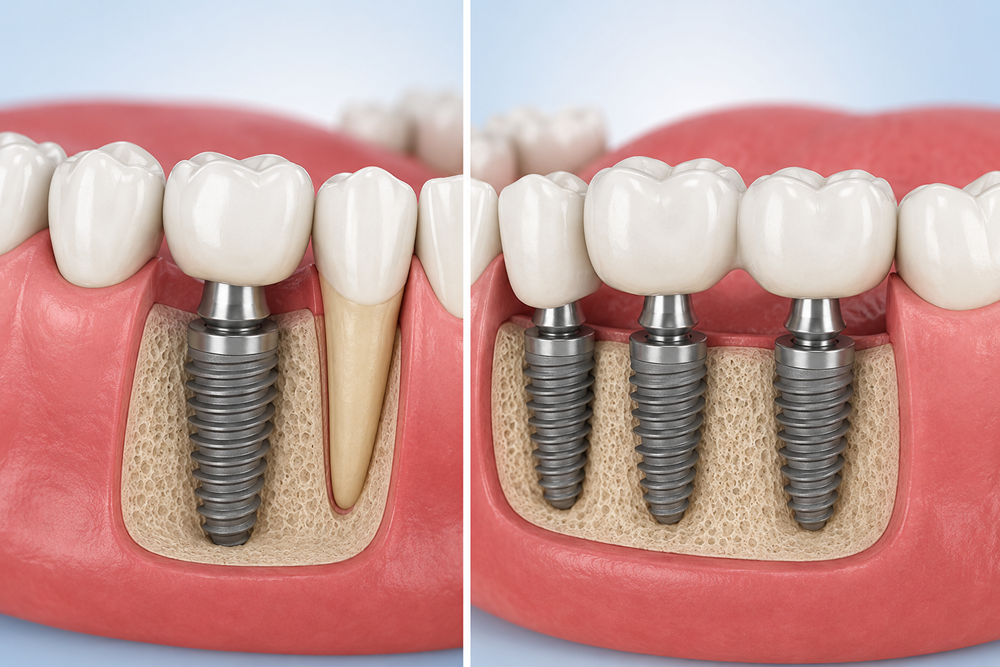
A single dental implant is used when one tooth is missing. It involves placing a titanium post into the jawbone, which acts as an artificial root. Once the post fuses with the bone — a process called osseointegration — a custom crown is attached on top, matching the colour and shape of your natural teeth.
The biggest advantage here is independence. A single implant doesn’t rely on neighbouring teeth for support, unlike a traditional bridge, so your healthy adjacent teeth remain untouched.
What Are Multiple Dental Implants?
Multiple dental implants come into play when two or more teeth are missing. There are actually two different scenarios hiding under this one term, and most articles blur them together:
- Multiple separate single implants: used when missing teeth are scattered across the mouth and not next to each other. Each gap gets its own implant and crown.
- Implant-supported bridge: used when several missing teeth are adjacent. Two implants are placed at either end of the gap, and a bridge of crowns spans across them — meaning you don’t need an implant for every missing tooth.
Think of an implant-supported bridge like a footb ridge over a stream: you don’t need a pillar every metre, just two strong supports at either end to hold the whole span.
Single vs Multiple Dental Implants: Side-by-Side Comparison
Factor | Single Implant | Multiple Implants (Bridge) |
Best for | One missing tooth | Two or more adjacent missing teeth |
Number of implant posts | One per missing tooth | Often fewer posts than missing teeth |
Cost per missing tooth | Higher individually | Generally lower per tooth |
Impact of one implant failing | Affects only that tooth | Can affect the entire bridge |
Healing time per implant | Several months for osseointegration | Similar per implant, but more sites heal at once |
Daily maintenance | Same as a natural tooth | May need interdental brushes or water flossers |
Bone density requirement | Localised to one site | Higher overall, since posts bear shared load |
Reliance on neighbouring teeth | None | None (unlike traditional bridges on natural teeth) |
This table is a starting reference, not a final answer — your dentist’s recommendation will always depend on your specific scan results. Furthermore, the table assumes typical cases; unusual bone conditions or bite issues can change the picture entirely.
Related Article: Why Invisalign Aligners
What Actually Determines Your Recommendation
Number and Location of Missing Teeth
A single missing front tooth is treated very differently from two missing molars side by side, even though both could be described as “a couple of missing teeth.” If your missing teeth are scattered rather than clustered, you’ll likely need separate single implants for each — “multiple implants” doesn’t always mean “implant bridge.”
Jawbone Density and Health
Multiple implants placed close together require sufficient bone density to support the shared load. During a consultation, your dentist will typically take a 3D scan to assess this. According to the American Academy of Implant Dentistry, implant-supported restorations have shown strong long-term success rates when bone health is properly evaluated beforehand.
This is where treatment plans often change. A patient expecting one implant may learn that bone density near the site is too low, requiring a graft or a different implant placement strategy.
Budget and Long-Term Cost Comparison
Per missing tooth, individual implants are typically more expensive than an implant-supported bridge covering the same gap, because a bridge uses fewer posts. However, a bridge means each implant bears more load, and if one fails, it can affect the entire structure.
This trade-off — lower upfront cost versus shared structural risk — is often the deciding factor for budget-conscious patients.
How Much Does It Cost? — Dental Implants Cost in Hyderabad
Cost is one of the most searched questions — and for good reason. The investment varies depending on how many implants are placed, which brand is used, whether any adjunct procedures are needed, and the technology available at the clinic.
Feature | Single Tooth Implant | Multiple Teeth Implants |
Best For | One missing tooth | 2 or more missing teeth |
No. of Implants | 1 implant + 1 crown | 2–6 implants (bridge/arch) |
Procedure Time | 1–2 appointments after healing | 2–4 appointments after healing |
Cost Range | ₹25,000 – ₹75,000 per tooth | ₹1,50,000 – ₹7,00,000+ (case-dependent) |
Healing Time | 3–6 months | 4–8 months (more surgical sites) |
Jawbone Preservation | Preserves bone at one site | Preserves bone across multiple areas |
Adjacent Teeth | Not affected | Not affected (vs. bridge requiring grinding) |
Long-Term Durability | Lifetime with proper care | Lifetime with proper care |
Maintenance | Brush & floss like natural teeth | Slightly more care needed for bridges |
Ideal Candidate | Healthy bone at single site | Adequate bone at implant anchor points |
A single titanium implant with abutment and crown typically ranges from ₹25,000 to ₹75,000 per tooth. Full-arch restorations like All-on-4 can range from ₹1,50,000 to ₹5,00,000 per jaw depending on the implant brand, materials used, and complexity of the case.
Premium implant brands such as Straumann or Nobel Biocare come at a higher price point but are backed by decades of clinical research and long-term outcome data. Many clinics also offer EMI payment options to make treatment accessible.
Related Article: Dental Implants Cost in Hyderabad
Healing Time and What to Expect
Recovery from a single implant generally involves a few days of swelling and mild discomfort, followed by a healing period of several months for osseointegration before the crown is attached.
When several implants are placed in one visit, the per-implant healing timeline doesn’t change dramatically — it’s the day-to-day discomfort that’s more noticeable, since multiple sites are healing at once. Most patients report the recovery feels more tiring rather than more painful.
Factors to Consider When Choosing
Beyond the comparison table, a few practical factors often tip the decision one way or the other, and they’re worth thinking through before your consultation rather than during it.
Time commitment: Multiple implants, particularly those involving a bone graft, can extend your overall treatment timeline by several months compared to a single implant. If you have a fixed deadline — a wedding, a job change, travel plans — mention this early, since it can shape which approach your dentist suggests.
Aesthetic priorities: For front teeth, even one implant carries higher aesthetic stakes than a back molar would. When multiple front teeth are involved, matching the shade, shape, and gum line across several crowns becomes more technically demanding, and it’s worth asking how your dentist plans to achieve a consistent look.
Future-proofing: If you’re missing one tooth now but have other teeth that are likely to fail in the coming years, it’s worth discussing this openly. Sometimes a slightly different implant placement today can make it easier to add implants later without redoing earlier work.
Making the Right Choice with Your Dentist
A good consultation should feel less like being told what to do and more like being walked through the reasoning. Before agreeing to any treatment plan, it’s reasonable to ask your dentist to explain what your scans showed, why a particular number and placement of implants is being recommended, and what the alternatives were and why they were ruled out.
It also helps to ask how the plan might change if something unexpected is found during surgery — this is rare, but knowing the answer in advance avoids surprises later. Furthermore, don’t hesitate to ask for the reasoning in plain language; a dentist who can explain the “why” clearly, not just the “what,” is generally a good sign of a transparent practice.
Ultimately, the comparison table earlier in this blog can help you walk into that conversation with better questions — but the final decision should always be a collaborative one between you and your dentist, based on your specific scans and goals.
Making the Right Call for Your Smile
At the end of the day, single vs multiple dental implants isn’t a question with one universal answer — it’s a question your dentist can only answer accurately after looking at your scans, your bone density, and the exact pattern of your missing teeth. The comparison table above gives you a solid starting point, but think of it as a conversation-starter rather than a final verdict.
If you’ve been putting off a decision because the options feel overwhelming, that’s exactly what a consultation is for. Book a consultation with Krishna Dental Hospitals today, and let our team walk you through a treatment plan built around your actual scans — not guesswork.
Author Bio
Dr. Naresh Krishna Reddy, BDS, MDS (Conservative Dentistry & Endodontics)
Dr. Naresh Krishna Reddy is the founder of Krishna Dental Hospitals and a practicing dentist in Hyderabad with over a decade of clinical experience across endodontics, implants, and full-mouth rehabilitation. He holds a BDS and an MDS in Conservative Dentistry & Endodontics from MNR Dental College & Hospital, Sangareddy, and is a member of the Indian Dental Association and the Indian Endodontic Society. Beyond root canal therapy, his clinical practice includes single and multiple dental implant placement, zirconium crown restorations, and treatment planning for full-arch cases — the same case-by-case assessment approach outlined in this article. He continues to see patients across KDH’s Kondapur and Kukatpally branches.