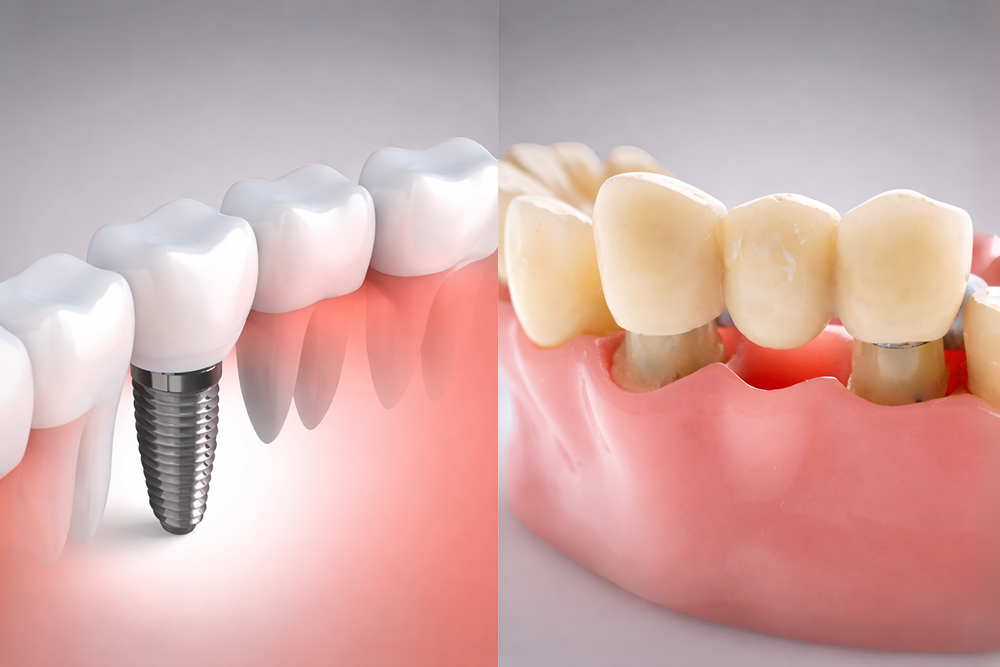
When you lose a permanent tooth, the decision between a dental bridge and a dental implant is the most critical choice you will make for your long-term oral health. A dental bridge is a non-surgical prosthetic that “bridges” the gap by anchoring to adjacent teeth, while a dental implant is a titanium post surgically placed into the jawbone to act as a root. Selecting the right option depends on your bone density, budget, and how quickly you need results. For those seeking expert guidance, consulting top-tier Dental Hospitals in Hyderabadcan help clarify which procedure aligns with your biological needs and lifestyle.
1. Structural Integrity: How They Support Your Jaw
The most significant “under-the-surface” difference between these two treatments is how they interact with your jawbone.
Dental Implants: These are the only restoration method that prevents bone resorption. Because the titanium post fuses with the bone (osseointegration), it stimulates the jaw just like a natural tooth root. This preserves your facial structure and prevents that “sunken” look often associated with tooth loss.
Dental Bridges: While aesthetically pleasing, bridges do not replace the tooth root. Over time, the bone underneath the missing tooth may begin to deteriorate. Furthermore, a traditional bridge requires the filing down of healthy “abutment” teeth to support the crowns, which can make those teeth more susceptible to future decay.
2. The Longevity Factor: Initial Cost vs. Lifetime Value
While many patients look at the upfront price tag, the “cost per year” tells a different story. Many residents visiting Krishna Dental Hospitals find that while implants require a higher initial investment, they often last 25 years to a lifetime. In contrast, dental bridges typically have a lifespan of 10 to 15 years and may require multiple replacements over a person’s life.
3. Procedure Timeline: Speed vs. Stability
If you have a major life event—like a wedding or a professional summit—and need a quick fix, the timeline becomes a deciding factor:
Bridges: Can usually be completed in 2 to 3 weeks. It involves two main appointments: one for preparation and impressions, and another for fitting the final bridge.
Implants: This is a journey, not a sprint. The process can take 3 to 6 months to allow the bone to heal and bond with the implant. However, the result is a tooth that feels entirely natural and doesn’t “slip” or move.
4. Maintenance and Daily Life
Maintaining a dental implant is exactly like maintaining a natural tooth—you brush and floss normally. Bridges, however, require a bit more “homework.” You must use specialized floss threaders to clean underneath the artificial tooth (pontic) to prevent plaque buildup and gum disease. If you are looking for low-maintenance solutions, visiting reputable Dental Hospitals in Kukatpally can provide you with a hands-on demonstration of how modern implant technology simplifies oral hygiene
5. Unique Comparison Table: At a Glance
Feature
Dental Implant
Dental Bridge
Surgical Required?
Yes
No
Impact on Other Teeth
None
Requires Shaving Adjacent Teeth
Bone Health
Prevents Bone Loss
Does Not Prevent Bone Loss
Success Rate
Over 95%
High (but depends on support teeth)
Natural Feel
High (Matches natural bite force)
Moderate
FINAL THOUGHT
Choosing between a bridge and an implant isn’t just about filling a gap; it’s about investing in your future health. While bridges offer a fast, cost-effective solution for the short term, implants provide unparalleled durability and bone protection. Your unique oral anatomy and health history are the ultimate deciders. We recommend scheduling a comprehensive consultation with a specialist to evaluate your bone density and create a personalized restoration plan that lasts.
Frequently Asked Questions (FAQs)
Q1: Is the dental implant procedure painful?
Most patients report that the procedure is less uncomfortable than a tooth extraction. Local anesthesia is used during the surgery, and any post-operative soreness can usually be managed with standard over-the-counter pain relief.
Q2: Can I get a bridge if my surrounding teeth are weak?
If the teeth adjacent to the gap are not strong enough to support a bridge, a dental implant is often the safer choice. Placing a bridge on weak teeth can lead to the failure of the entire restoration.
Q3: Does insurance cover dental implants?
In 2026, many insurance providers have expanded their coverage to include at least a portion of dental implant costs because they recognize the long-term health benefits. It is best to check your specific policy or speak with your clinic’s billing department.
Q4: How do I know if I have enough bone for an implant?
Dentists use 3D CBCT scans to measure the height and width of your jawbone. If you lack sufficient bone, a simple procedure called a bone graft can be performed to “build up” the area before the implant is placed.
Q5: What is the main disadvantage of a dental bridge?
The primary drawback is the necessity to alter healthy natural teeth. To anchor the bridge, the teeth on either side must be permanently reshaped, which removes healthy enamel and may shorten the lifespan of those teeth.