A dental bridge and a dental implant can both replace a missing tooth, but they work differently. A bridge fills the gap by taking support from neighbouring teeth. An implant is placed in the jawbone and supports its own crown.
Bridges are usually quicker and less expensive at the beginning. Implants generally take longer, involve surgery and cost more upfront, but they usually avoid reshaping healthy nearby teeth. The right choice depends on the condition of those teeth, available bone, gum health, medical history, treatment time and budget.
What Is A Dental Bridge?
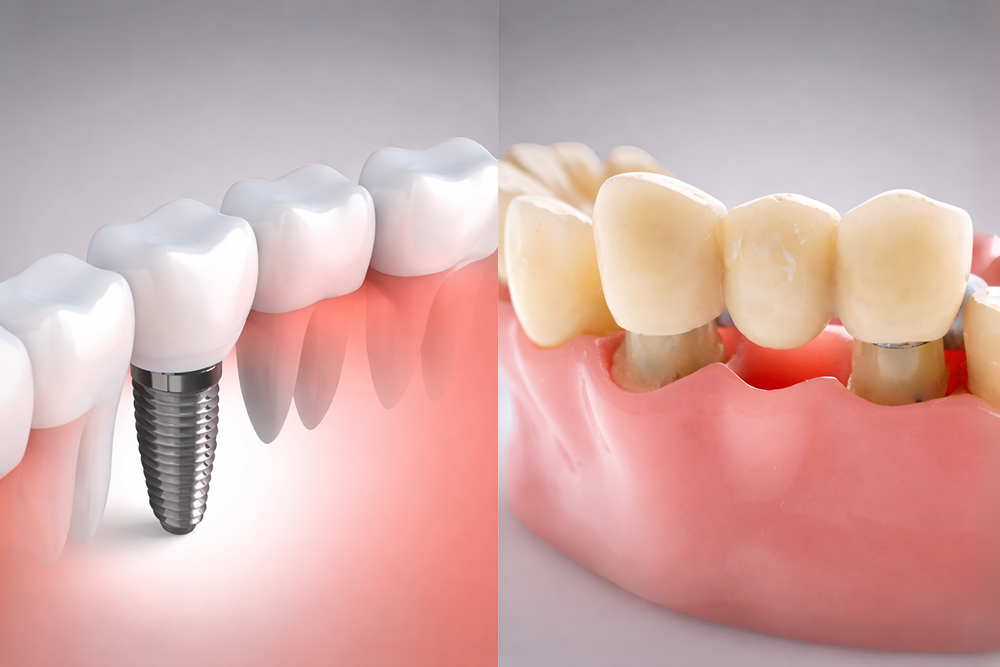
A dental bridge is a fixed restoration used to replace one or more missing teeth. In a conventional three-unit bridge, the teeth on either side of the space are shaped for crowns. Those crowns support an artificial tooth, called a pontic, between them. The bridge is cemented in place and can only be removed by a dentist.
A bridge may make practical sense when the neighbouring teeth already contain large fillings, are fractured or need crowns. It can also be considered when implant surgery is unsuitable, bone grafting would add unwanted complexity, or the patient needs a fixed replacement sooner.
A dental implant is a medical device surgically placed in the jawbone to support a crown, bridge or denture. A single-tooth implant usually has three parts: the implant body inside the bone, an abutment and a custom crown above the gum.
Bone heals around the implant surface through a process known as osseointegration. This commonly takes several months, although timing varies according to the tooth position, bone condition, grafting requirements and treatment plan. Overall health, smoking and healing capacity can also influence suitability and recovery.
An implant normally stands independently and does not require the dentist to prepare the teeth beside the gap. It can also help maintain bone at the missing-tooth site, although it cannot guarantee that no bone change will occur.
Fixture may function for decades; the crown may require replacement
Initial cost
Usually lower
Usually higher
Main consideration
Health of supporting teeth
Bone, gum and general health
Which Lasts Longer: A Bridge or an Implant?
A well-made dental bridge can provide reliable service for many years. The average dental bridge lifespan is generally around five to 15 years. Its longevity depends on oral hygiene, the health of the supporting teeth, bite forces, restoration material and regular dental care.
Implants also have strong long-term survival, but statements such as “dental implants last a lifetime” are too absolute.
A systematic review of single implants followed for at least ten years reported implant-level survival of approximately 95%. However, the survival of the original crowns was lower, meaning some patients required crown repair or replacement even though the implant itself remained stable.
In practical terms, an implant fixture may remain functional for decades, but the crown, screw or another prosthetic component may eventually need maintenance.
This distinction matters when comparing long-term value. If decay develops beneath one of the supporting crowns of a bridge, the complete bridge may need to be removed. With an implant, complications may involve the crown, connecting screw, gum tissue or supporting bone.
Both treatments require daily cleaning and regular professional examinations.
Which Lasts Longer: A Bridge or an Implant?
Dental bridges commonly last between five and 15 years. Some remain functional for longer when the supporting teeth are strong, the bridge is well designed and the patient maintains good oral hygiene.
A bridge may need replacement because of:
Decay around a supporting tooth
Gum disease
Loss of cement
Fracture or chipping
Damage to an abutment tooth
Difficulty cleaning beneath the artificial tooth
Because the supporting teeth and artificial tooth are connected, a problem affecting one part of the bridge can affect the whole restoration.
Dental implants generally demonstrate strong long-term survival, but statements such as “an implant lasts for life” should not be treated as guarantees.
The implant post, abutment and crown are separate components. The implant post may remain stable for many years, while the crown or screw may eventually need repair or replacement. Gum inflammation and bone loss can also occur around an implant when plaque is not controlled.
A systematic review following single implants for at least 10 years found that approximately 95% of the implants assessed were still functioning. This represents survival, not a guarantee that every crown remained free from repairs or maintenance.
Dental Bridge vs Implant Cost in Hyderabad
Cost is one of the main reasons people compare dental bridges with dental implants.
A traditional bridge usually has a lower initial fee because it does not involve implant surgery or a healing period. However, replacing one missing tooth normally requires a three-unit bridge. The quotation should therefore include both supporting crowns and the artificial tooth, not just the missing tooth.
The existing KDH information gives an indicative range of approximately ₹15,000 to ₹40,000 for a three-unit bridge. The actual amount can vary according to the bridge material, number of units, condition of the supporting teeth and whether those teeth require additional treatment.
Published KDH information places a single dental implant within an approximate range of ₹25,000 to ₹50,000. This amount can vary depending on the implant system, crown material, surgical complexity and bone condition.
An implant estimate should clearly state whether it includes:
Implant fixture
Surgical placement
Abutment
Final crown
Temporary tooth, when required
Follow-up examinations
Dental imaging
Bone grafting, if needed
Do not compare only the lowest advertised prices. Ask for a written, itemised estimate showing what is included and which procedures could increase the final cost. More information is available in Dental Implant Cost in Hyderabad.
When Might an Implant Be the Better Option?
A dental implant may be considered when:
One tooth is missing and both neighbouring teeth are healthy
Preserving natural tooth structure is a priority
There is adequate bone to support an implant
Bone grafting is possible and clinically appropriate
The patient is comfortable undergoing surgery
A longer treatment period is acceptable
Cleaning beneath a conventional bridge may be difficult
Several missing teeth can be restored with an implant-supported bridge
For multiple missing teeth, one implant is not always required for every tooth. An implant-supported bridge may replace several teeth using fewer implant posts. Read Single vs Multiple Dental Implants to understand how these treatment plans differ.
When Might a Dental Bridge Be the Better Option?
A bridge may be a reasonable choice when:
The teeth beside the gap already need crowns
The patient wants to avoid implant surgery
Medical or anatomical factors make surgery unsuitable
Extensive bone grafting would be required and is not desired
A fixed replacement is needed sooner
The initial cost of implant treatment is not manageable
A bridge should not be viewed simply as a cheaper version of an implant. It is a separate restorative treatment with its own advantages and indications.
When the supporting teeth are suitable and the bridge is properly maintained, it can restore chewing, speech and appearance effectively. Bridges may also prevent neighbouring teeth from drifting into the empty space.
Is It Worth Replacing the Tooth at All?
Almost always, yes. Leaving a gap allows neighbouring teeth to drift, the opposing tooth to over-erupt, and the jawbone to shrink — problems that cost more to fix later. Whether you choose a bridge or an implant, replacing a missing tooth protects your bite, your alignment, and your facial structure.
If you lack sufficient bone — often the case when a tooth has been missing for years — a straightforward procedure called a bone graft can rebuild the area first. This makes implants possible for many patients who were previously told they couldn’t have one.
Final Decision: Implant or Bridge?
For one missing tooth with healthy teeth on both sides, an implant often preserves more natural tooth structure and provides an independent replacement.
A dental bridge can be equally sensible when the supporting teeth already require crowns, implant surgery is inappropriate or the patient prefers a faster treatment process.
The decision should not be based on a claim that one treatment is always better. Before choosing, ask:
What will happen to the neighbouring teeth?
Is there enough healthy bone for an implant?
How will the restoration be cleaned?
How long will the treatment take?
What does the quotation include?
What repairs or replacements may be required later?
A personalised examination by a dentist or prosthodontist is the safest way to select a tooth replacement that suits your oral health, treatment priorities and budget.
Author Bio
Dr. Naresh Krishna Reddy, BDS, MDS (Conservative Dentistry & Endodontics)
Dr. Naresh Krishna Reddy is the founder of Krishna Dental Hospitals and a practicing endodontist in Hyderabad. He holds a BDS and an MDS in Conservative Dentistry & Endodontics from MNR Dental College & Hospital, Sangareddy, and is a member of the Indian Dental Association and the Indian Endodontic Society. He has personally performed over 1,500 root canal treatments and has a special interest in minimally invasive endodontics and smile design.