
Dental Implants vs Dentures vs Bridges
A missing tooth forces a decision most people have never had to make before, usually while they’re still a little sore and want it settled quickly. That’s exactly the wrong moment to choose based on whichever option the first clinic you call happens to push hardest.
Dental implants, dentures, and bridges all replace a missing tooth, but they’re genuinely different commitments — in money, in time, and in what they do to the teeth and bone around them. This guide compares all three honestly, including the trade-off almost no one mentions: which option keeps your future choices open, and which one quietly closes doors you might want later.
A quick note before you read on: This article is for general information only and isn’t a substitute for an in-person dental examination. Suitability for any of these options depends on your bone density, gum health, remaining teeth, and overall health — factors that can only be properly assessed by a dentist looking at your mouth and X-rays. Cost figures below are indicative Hyderabad-market ranges, not quotes; please confirm exact pricing at a consultation.
Dental Implants vs. Dentures vs. Bridges: The Quick Answer
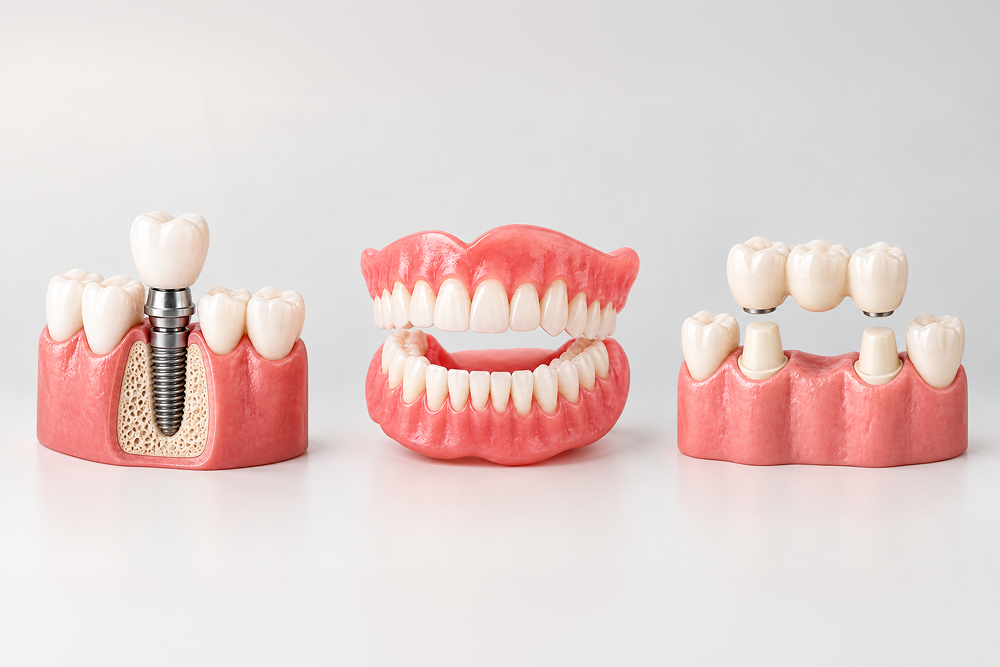
A dental implant is a titanium post surgically placed in the jawbone to act as an artificial root, topped with a crown. A dental bridge is a fixed structure that spans a gap by anchoring to the two neighbouring teeth. A denture is a removable prosthesis that sits on the gum, replacing one or several teeth without touching adjacent ones. Each restores chewing and appearance; they differ sharply in cost, lifespan, and long-term impact on your mouth.
Factor | Dental Implant | Dental Bridge | Denture |
Typical cost in Hyderabad* | ₹25,000–₹60,000 per tooth | ₹15,000–₹30,000 per unit | ₹8,000–₹40,000+ |
Typical lifespan | 20–30 years with care | 7–15 years | 5–8 years before relining/replacement |
Treatment time | 3–6 months (includes healing) | 2–3 weeks | 1–3 weeks |
Touches neighbouring teeth? | No | Yes — they’re filed down | No |
Helps prevent jawbone loss? | Yes | No | No |
Removable for cleaning? | No | No | Yes |
*Ranges are directional, based on typical Hyderabad clinic pricing; your actual cost depends on tooth position, materials, and case complexity — confirm at consultation.
What Each Option Actually Involves
Dental Implants
A titanium post fuses with the jawbone over several months — a process called osseointegration — before a custom crown is fitted on top. Research on post-extraction bone change shows that roughly 30% of the width of the jawbone ridge can be lost, mostly within the first three to six months, if the socket is left without an implant or graft; an implant is the only one of the three options that meaningfully counters that.
👉 Related read: Dental Implants in Hyderabad — Cost, Types & Procedure
Dental Bridges
A bridge fills the gap with an artificial tooth (pontic) fused between two crowns, which are cemented onto the healthy teeth on either side. It’s faster and cheaper upfront than an implant, but those two neighbouring teeth are permanently reduced in size to hold the crowns — healthy tooth structure you don’t get back.
👉 Related read: Dental Bridges vs. Dental Implants: Which Is the Best Choice for You?
Dentures
A removable appliance — partial or complete — that replaces one, several, or all teeth without involving the neighbouring teeth at all. According to the American Dental Association, modern dentures can restore the ability to eat and speak comfortably, though most wearers go through an adjustment period and need periodic relining as the gum and bone shape changes underneath.
👉 Related read: Dentures in Hyderabad: Types, Cost & What to Expect
The Question That Matters More Than Cost: Can You Change Your Mind Later?
This is the comparison competitors skip. A bridge is the least reversible of the three — once two healthy teeth are filed down to hold the crowns, that decision is permanent, even if you later decide you’d have preferred an implant. If one of those abutment teeth ever needs a root canal or eventually fails, your options narrow rather than staying open. A denture, by contrast, is the most reversible: it can be adjusted, remade, or upgraded to an implant-supported version later without having touched a single healthy tooth. An implant sits in the middle — it’s a bigger upfront surgical commitment than a denture, but because it doesn’t touch neighbouring teeth, it doesn’t foreclose anything else either.
For someone in their 30s or 40s, this matters more than it first appears. This isn’t the only tooth-replacement decision you’re likely to make in a lifetime, and the option you pick now can either preserve or spend down the choices available to you at the next one.
Which One Fits Your Situation
- Single missing tooth, healthy neighbours, adequate bone: an implant is usually the strongest long-term fit, since there’s no reason to cut into two healthy teeth when the bone can support a standalone post.
- A few teeth missing in a row, and surgery isn’t an option medically: a bridge remains a reasonable, faster route to a fixed (non-removable) result.
- Several or most teeth missing, budget-constrained: a conventional denture is the most accessible starting point, with the option to move to an implant-supported denture later if the budget allows.
- Full arch missing, want a fixed result without individual implants per tooth: an implant-supported bridge or overdenture — a handful of implants anchoring a full arch — is worth discussing at consultation rather than assuming it’s out of reach.
A useful, if slightly uncomfortable, mini-example: a patient who loses a molar at 35 and chooses a bridge to save money will very likely need that bridge replaced by their late 40s or 50s — at which point the bone underneath may have thinned enough that an implant, if reconsidered then, requires bone grafting it wouldn’t have needed at 35. That’s not a reason every bridge is a mistake; it’s a reason cost-per-year, not cost-upfront, is the number worth comparing.
What Happens While You're Waiting
One thing almost no comparison article mentions: an implant takes months to complete, and you’re not expected to walk around with a visible gap for that entire time. A temporary partial denture (sometimes called a “flipper”) or a temporary bridge can be fitted to cover the gap while the implant integrates with the bone underneath — a practical detail worth asking about at your first consultation rather than discovering later.
Practical Takeaways
- Compare cost per year of expected lifespan, not just the upfront price — a cheaper option replaced twice can cost more over 15 years than the pricier one done once.
- Ask specifically whether your neighbouring teeth are healthy before agreeing to a bridge, since that decision can’t be undone.
- If budget is the main constraint, ask about a denture now with a documented path to an implant-supported upgrade later, rather than assuming it’s all-or-nothing.
- Ask what temporary option covers the gap during implant healing — you shouldn’t have to choose between a visible gap and rushing a permanent decision.
- Get a written cost estimate that separates the procedure, materials/brand, and any follow-up work (crown, relining, adjustments).
- If you’re unsure, ask directly what happens to your options ten years from now under each choice — not just what happens this year.
- Bring any old X-rays or dental records to your consultation; bone volume, visible on X-ray, often decides which options are realistically on the table.
Frequently Asked Questions
1. Which is cheaper: implants, dentures, or bridges?
Dentures are typically the least expensive upfront, bridges sit in the middle, and implants cost the most initially — but implants generally last the longest, which can make them more cost-effective over 15–20 years.
2. Can I switch from a denture to an implant later?
Often, yes, particularly with a conventional denture, since it doesn’t involve any permanent changes to neighbouring teeth. Bone volume at that later point will determine whether grafting is needed first.
3. Do dental bridges damage the neighbouring teeth?
The neighbouring teeth need to be filed down to hold the bridge’s crowns, which is a permanent change to otherwise healthy tooth structure — a genuine trade-off against the bridge’s lower upfront cost and faster timeline.
4. How long does it take to get a dental implant?
Typically three to six months from placement to final crown, since the implant needs time to fuse with the jawbone before it can safely support a crown.
Conclusion
There’s no single best answer among dental implants, dentures, and bridges — the right one depends on your bone, your budget, and how much you value keeping future options open versus solving the problem quickly. What matters is comparing them on the right terms: cost per year rather than cost upfront, and what each one does or doesn’t foreclose down the line. If you’d like a straight answer for your specific case, book a free consultation at your nearest Krishna Dental Hospitals branch and get an honest read on which of the three actually fits your mouth.
Author BIO
Dr. Naresh Krishna Reddy, BDS, MDS (Conservative Dentistry & Endodontics) Founder & Managing Director, Krishna Dental Hospitals, Hyderabad
Dr. Reddy completed his BDS and MDS in Conservative Dentistry & Endodontics from MNR Dental College and is a member of the Indian Dental Association (IDA) and the Indian Endodontic Society. He has personally performed over 1,500 root canal treatments and oversees clinical quality standards across all Krishna Dental Hospitals branches in Hyderabad, with a continued focus on preventive dentistry and patient-first treatment planning.