
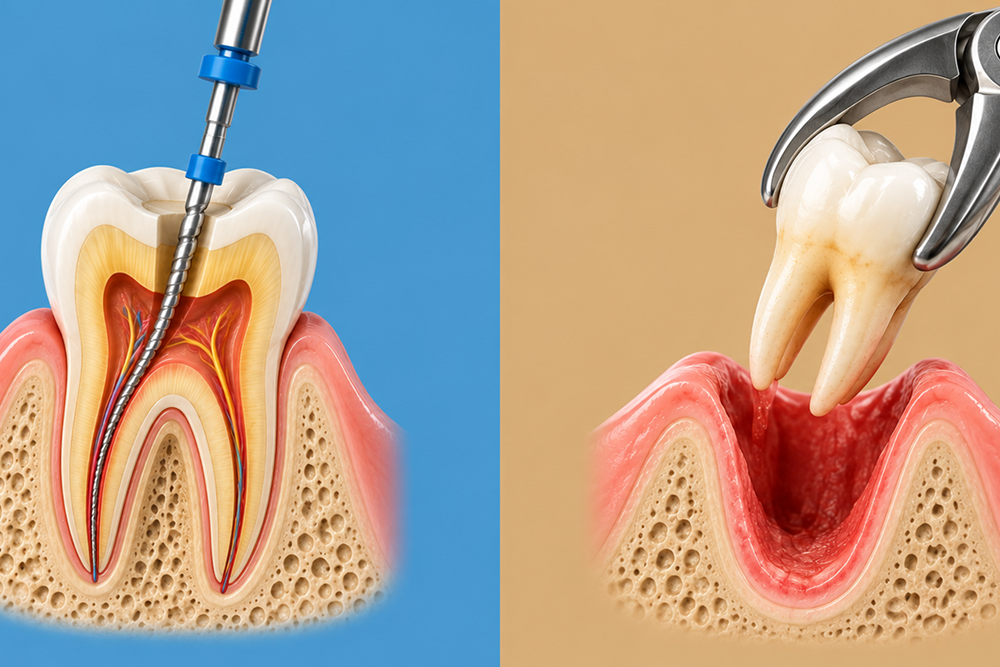
Root Canal vs Extraction: Which Should You Choose?
Your dentist says the tooth can technically be saved with a root canal, or you could just have it pulled. That single sentence is where most people’s decision-making stalls — not because the choice is unclear, but because it’s actually two different questions being asked at once, and nobody separates them for you.
The first question is clinical: can this specific tooth realistically be saved? The second is personal: even if it can, is that the right call for you, this tooth, and your budget? This guide splits those two questions apart, walks through both honestly, and covers the option almost nobody names out loud — doing neither, for now — so you can make the decision with your eyes open rather than under pressure in the dentist’s chair.
Root Canal vs. Tooth Extraction: The Quick Answer
A root canal removes infected or damaged pulp from inside a tooth, then cleans and seals the canal, letting you keep the natural tooth. A tooth extraction removes the entire tooth from its socket, ending the problem but leaving a gap that will eventually need attention. Root canal treatment is generally preferred when enough healthy tooth structure remains to support a restoration; extraction becomes necessary when the damage, fracture, or infection has gone past the point where the tooth can be reliably rebuilt.
The Two Questions Everyone Conflates
Almost every article on this topic treats “root canal or extraction” as a single decision driven purely by how bad the damage looks. It’s actually two separate questions, and mixing them up is exactly what makes this feel harder than it needs to be.
Question One: Can the Tooth Actually Be Saved?
This one isn’t really your call to make — it’s a clinical finding. Your dentist is checking specific things: how much healthy tooth structure remains above the gumline, whether a crack extends below it (a crack running under the gumline is one of the clearest signals toward extraction), how much bone and gum support the root still has, and whether the tooth would realistically hold up under a crown afterward. If the answer to “can it be saved” is genuinely no, there’s no real decision to make — extraction is the answer, and the more useful question becomes what replaces it.
Question Two: Should It Be Saved?
This is where things get more personal, and where competitor content mostly stops short. A molar can be technically salvageable with a root canal and still not be the better choice — if it’s already had one failed root canal, if the surrounding gum has significant bone loss regardless of the tooth itself, or if you’re weighing a second procedure and crown against simply extracting and moving to an implant in one clean step. The American Association of Endodontists notes that patients who choose root canal treatment are considerably more likely to describe the experience as painless than those who choose extraction — a genuinely useful data point, but it answers “which hurts less,” not “which is right for this tooth.” [EXPERT QUOTE: how KDH’s team walks a patient through “can vs. should” when a tooth is a borderline case — source to be added by editor]
👉 Related read: Signs You Need a Root Canal – Don’t Ignore These Symptoms
What Happens If You Do Neither, For Now
This is the option almost no comparison article names directly, even though it’s what a lot of readers are quietly considering: waiting. Cost, fear, or simply not having time this month are all real reasons people delay. It’s worth being honest about what that actually does rather than pretending the choice is only ever between two active treatments.
An infected or badly damaged tooth left untreated doesn’t stay the same — Mayo Clinic’s guidance on tooth infections notes that untreated dental infections can spread deeper into the jaw, throat, or surrounding tissue over time, which is part of why a fever alongside facial swelling is treated as urgent. Short of that extreme, a persistently painful tooth also changes how you chew day to day, and that uneven pressure gradually affects the teeth around it. None of this means you need to decide today. It does mean “I’ll deal with it later” has a cost that’s worth weighing against the cost of treating it now.
Which One Actually Fits Your Situation
- Enough healthy structure remains, and you’d rather keep your natural tooth: root canal is usually the stronger long-term option, particularly for front teeth and premolars where appearance and bite alignment matter most.
- The crack runs below the gumline, or the tooth has failed a previous root canal: extraction, followed by a planned replacement, is often the more honest answer even if a root canal is technically attempted first.
- Cost is the deciding factor, not the tooth’s condition: ask your dentist directly to compare cost-per-year of expected outcome, not just the upfront number — a cheaper extraction followed by years without replacement can cost more in shifted teeth and bite problems than paying for the root canal now.
- You’re not in pain and want to “wait and see”: ask specifically what waiting changes about your options a year from now, so it’s an informed pause rather than an accidental default.
Practical Takeaways
Use these as a checklist for your next appointment, whichever way the decision is leaning:
- Ask your dentist directly whether the answer is a clinical “it can’t be saved” or a judgment call — the two deserve different conversations.
- If extraction is recommended, ask what replacement options fit your case before you leave that appointment, not months later.
- Compare cost-per-year of the likely outcome, not just the upfront price of either procedure.
- If you’re choosing to wait, ask what specifically changes if you wait six months versus acting now.
- For a borderline tooth, ask about the tooth’s remaining bone and gum support, not just the visible crack or cavity.
- Don’t let fear of pain be the deciding factor — modern root canal treatment is typically comparable to a filling under local anaesthesia.
- Get a written estimate for both paths, including likely follow-up costs (crown for a root canal, or replacement for an extraction).
Frequently Asked Questions
1. Is a root canal more painful than an extraction?
Generally no — both are done under local anaesthesia, and root canal patients commonly report the procedure itself as comparable to getting a filling. Some soreness afterward is normal with either option.
2. Is it cheaper to extract a tooth than to save it?
Extraction usually costs less upfront, but if the missing tooth is later replaced with an implant, bridge, or denture, the total cost often ends up higher than a root canal and crown would have been.
3. Can a tooth that’s had a root canal still need extraction later?
Occasionally, yes — if the treatment doesn’t fully resolve the infection, the tooth develops a new fracture, or the surrounding bone support declines independently of the treated tooth itself. It’s a real limitation worth knowing about upfront, not a reason to assume every root canal is a permanent, unconditional fix.
4. What happens if I just wait and don’t decide right now?
Waiting doesn’t stop an infected or damaged tooth from changing over time — pain, infection, and pressure on neighbouring teeth can all progress. It’s a reasonable short-term choice, but ask your dentist what it changes about your options later.
Conclusion
Root canal vs. extraction isn’t really one decision — it’s whether the tooth can be saved, and separately, whether saving it is genuinely the better move for you. Treating those as two questions instead of one makes the choice much less confusing, and it’s a fairer way to think about it than any single “which is better” headline can offer. If you’re facing this decision right now, book a consultation at your nearest Krishna Dental Hospitals branch and get a straight answer to both questions for your specific tooth, not a generic one.
Author BIO
Dr. Naresh Krishna Reddy, BDS, MDS (Conservative Dentistry & Endodontics) Founder & Managing Director, Krishna Dental Hospitals, Hyderabad
Dr. Reddy completed his BDS and MDS in Conservative Dentistry & Endodontics from MNR Dental College and is a member of the Indian Dental Association (IDA) and the Indian Endodontic Society. He has personally performed over 1,500 root canal treatments and oversees clinical quality standards across all Krishna Dental Hospitals branches in Hyderabad, with a continued focus on preventive dentistry and patient-first treatment planning.